

Existing Homes VS BASIX DIY results.
Bridging the Gap: What Happens When an Existing Home Assessment Meets a DIY BASIX?
This week, I conducted an Existing Home Assessment (EHA) on a property built in 2021. What made this job particularly fascinating was that the client still had the original development application documents, including the property's initial DIY BASIX certificate.
For those of us well-versed in the legacy NSW BASIX 3.0 tool (prior to the shift to the 7-star minimum in October 2024), we knew the benchmarks well. A DIY BASIX pass was generally understood to align with a 5.2 to 5.3-star NatHERS thermal comfort rating. That was the theory, at least. But as any assessor knows, theory and the "real world" can diverge drastically.
The project itself was a substantial 270m² floor area that I mapped out using a Magicplan scan. After navigating a few minor instances of scan-to-plan drift, I completed the modeled home assessment in ACCU-RATE. When the initial result generated, I was immediately intrigued: the NatHERS rating wasn't anywhere near the expected 5.2-star DIY equivalent.
Instead of brushing it off, my professional curiosity got the better of me. I retraced my steps and scrutinized the model. Sure enough, I found a missing piece of the puzzle: I had visually identified wall insulation between an attic room and the roof space while on-site, but had inadvertently left it out when constructing the walls in the software. Once I corrected this and factored the insulation in, the rating jumped cleanly to 5.3 stars.
Years ago, when I first started working doing Scorecard ratings and new home assessments, the stark procedural differences between "off-plan" and "as-built" evaluations were jarring. I came to accept that assessing a conceptual drawing and auditing a real-world structure were simply two different animals, naturally yielding different results.
While a single project doesn't make a definitive trend, this specific case provided a deeply satisfying moment of alignment. It offers some genuine faith that the DCCEEW's push toward using NatHERS methodologies for Existing Home Assessments is working. At least in this instance, the star bandings achieved equivalency, proving that the gap between how we predict performance and how we measure it in the real world might be narrower than we think.
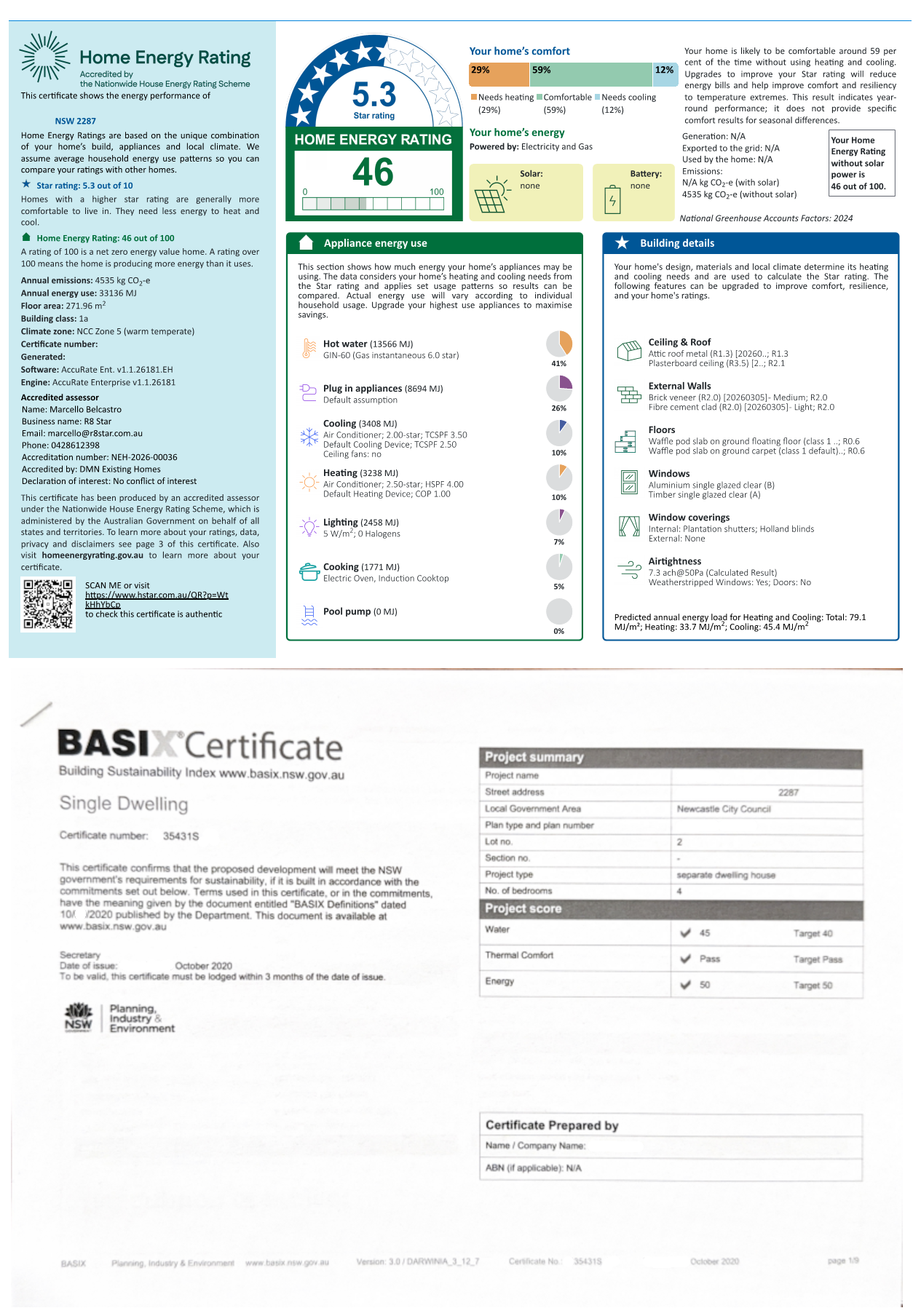
Address data and identifiable data removed from the BASIX V3.0 and Existing home certificates issued.