

What is the energy rating of my house?
A Beginner’s Guide to NatHERS & BASIX in NSW
Building your first home in New South Wales is an exciting journey, but navigating building approvals and technical jargon can quickly feel overwhelming. You will likely hear your builder or designer talk about your home's "energy rating," "NatHERS star rating," and "BASIX certificate."
Understanding these benchmarks is essential because they dictate how comfortable your house will be to live in and ensure your building plans meet state and national environmental laws.
What Is a Home Energy Rating?
A home energy rating measures how efficiently your proposed building design maintains a comfortable indoor temperature throughout the year. Instead of testing an already built structure, energy rating software evaluates your architectural drawings before construction begins.
The software models your home's predicted heating and cooling energy needs based on standard household usage patterns, local climate data, and the building's physical materials.
The 0 to 10 Star Scale: NatHERS Explained
In Australia, thermal performance is rated using the Nationwide House Energy Rating Scheme (NatHERS). NatHERS scores homes on a scale from 0 to 10 stars:
0 Stars: Means the building envelope provides practically no defense against hot or cold weather, requiring constant artificial heating and cooling.
7 Stars (The New Minimum Baseline): Indicates a high-performing design that naturally stays comfortable year-round, requiring minimal artificial heating and cooling.
10 Stars: Represents an exceptionally efficient home that requires virtually no artificial heating or cooling to stay comfortable.
Under current National Construction Code (NCC 2022) regulations and NSW planning laws, all new houses must achieve a minimum thermal rating of at least 7 stars.
What Factors Drive Your Star Rating?
NatHERS software evaluates your building fabric (shell). Key elements assessed include:
Orientation: How your living spaces and windows face the sun to catch winter warmth and avoid harsh summer heat.
Insulation: The R-value rating of insulation installed in ceilings, external walls, and floors.
Glazing & Windows: Window sizes, frame types, and glass specifications—specifically U-values (heat loss) and Solar Heat Gain Coefficients (SHGC).
Building Materials & Roof Colour: Thermal mass (e.g., concrete slabs) and roof surface solar absorptance (light vs. dark colours).
Shading & Ventilation: Eaves, pergolas, window placement, and ceiling fans.
Why Heating and Cooling Load Caps Matter
Achieving 7 stars overall is only part of the equation. NatHERS and NSW regulations enforce separate heating load limits and cooling load limits (known as thermal caps).
These separate caps prevent a "seasonal trade-off"—ensuring a house doesn't pass overall by performing exceptionally well in winter while remaining uncomfortably hot during summer (or vice versa).
How NatHERS Fits into BASIX in New South Wales
If you are building in NSW, you must obtain a BASIX (Building Sustainability Index) certificate. Introduced by the NSW Government in 2004, BASIX is a mandatory planning tool integrated into the Development Application (DA) process.
BASIX evaluates three main sustainability categories:
Thermal Comfort: Ensures your home's building fabric meets minimum heating and cooling load caps. Your accredited assessor imports the NatHERS software calculations directly into this module.
Energy: Sets benchmarks to reduce greenhouse gas emissions from fixed household appliances, including domestic hot water systems, heating and cooling equipment, lighting, and renewable solar PV systems.
Water: Sets target reductions for potable water usage through water-efficient showers, taps, toilets, rainwater tanks, or recycled water systems.
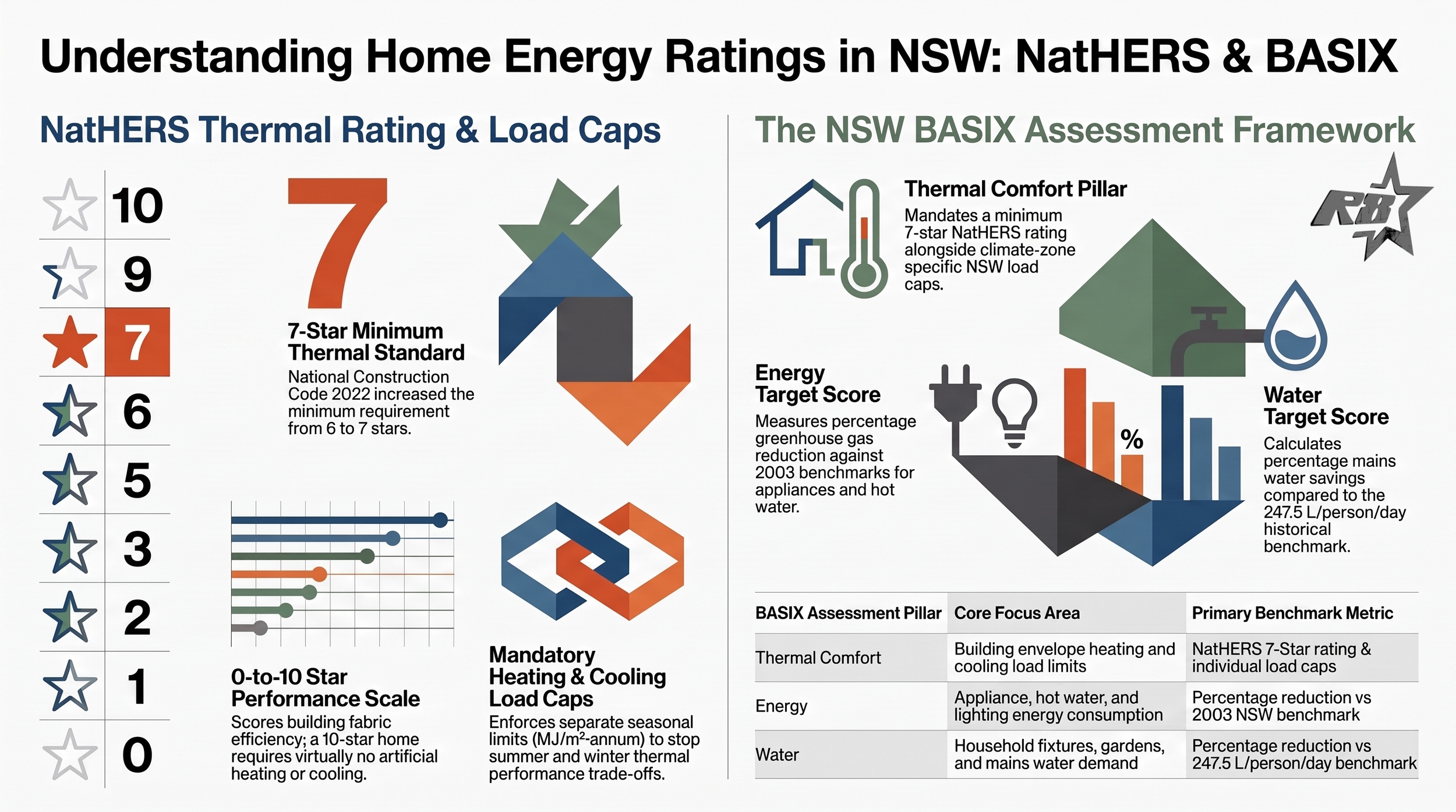
A beginner’s roadmap to home energy performance in NSW, illustrating the 7-star NatHERS scale, separate heating and cooling load caps, and the three pillars of BASIX certification.
Your Step-by-Step Guide to Getting Certified
To gain approval to build your new home in NSW, follow these simple steps:
Engage an Accredited NatHERS Assessor: Work with a certified energy assessor during the design phase.
Thermal Modelling: The assessor inputs your architectural plans into accredited NatHERS simulation software (such as BERS Pro, FirstRate5, Hero, or AccuRate) to optimize your design for a 7-star rating.
Generate NatHERS Certificate: Once compliant, the software produces an official NatHERS Assessor Certificate detailing your star rating and thermal loads.
Complete the BASIX Assessment: Your design details and appliance specifications are logged in the online BASIX tool to pass the Water, Energy, and Thermal Comfort targets.
Submit for Approval: Your official BASIX Certificate and stamped architectural drawings are submitted to your local council or private certifier for Development Application (DA) or Complying Development Certificate (CDC) approval